On the Veneration of the Holy Hierarch Jonah (Pokrovsky), Bishop of Hankow, Wonderworker of Manchuria, in the Russian Diaspora
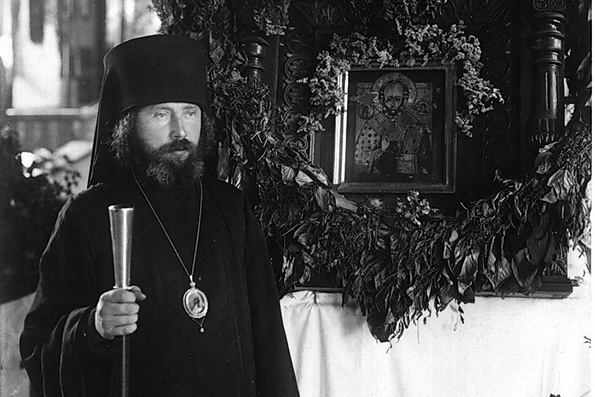
Immediately after Bishop Jonah’s repose on October 20, 1925, a remarkable event affirmed the depth of his holiness. He appeared in a dream to a young boy with a severe leg ailment, telling him: “Take my legs—I no longer need them—and give me yours.”
The late Archpriest Nikolai Kiklovich of the Harbin Diocese later recounted this miracle, noting that the people’s love for Bishop Jonah did not diminish with his death. Instead, they began to revere him even more—not simply as a man, but as a saint of God. This was most clearly seen in the healing of the boy Nikolai, whom medicine had completely abandoned. As Archpriest Nikolai described, God’s power came to the suffering child through the prayers of the newly departed Bishop.
Years later, in 1944, Archpriest Nikolai met this same boy—once eight years old and crippled, now a healthy 27-year-old man. He was married, the father of two teenage daughters, the owner of his own home, and fully capable in his daily labors. He described how, after the dream of Bishop Jonah, he awoke in the middle of the night completely healed. Rising to his feet, he threw aside his crutches and walked around the room. This boy, Nikolai Dergachev, remained healed for the rest of his life and lived to an advanced age, passing away only in the summer of 1994 in Kurgan, Russia.
Bishop Jonah’s funeral itself reflected the extraordinary reverence he inspired. Metropolitan Mefody of Harbin and Manchuria presided, accompanied by a great host of clergy and 8,000 worshippers—even though the entire population of Manchuria numbered only 10,000.
In the years following his repose, devotion to Bishop Jonah continued to grow. A collection of miraculous events attributed to his prayers was published, and each year deepened the faithful’s conviction in his intercession. From dawn until dusk, pilgrims visited his grave to pray, to pour out their grief, or to seek a blessing before life’s important undertakings. Brides and grooms came before their marriage; workers stopped by before beginning their day; and the residents of the orphanage and assisted living facility he had founded developed a lasting tradition of venerating his grave.
By the mid-1990s, many of Saint Jonah’s spiritual children longed to recover his remains and transfer them to Holy Trinity Monastery in Jordanville, where they could be venerated by all who cherished his memory. In February 1994, representatives of the “Society of Former Manchurians” from San Francisco traveled to China and received permission to search for his burial place. That July, on the feast of St. Vladimir—Bishop Jonah’s baptismal name—they began excavations near the altar wall of St. Innocent’s Cathedral, which had been destroyed in 1964. Sadly, the relics were never found and were likely lost during the cathedral’s destruction.
Later that year, at its second session, the Council of Bishops of the Russian Orthodox Church Abroad praised the Society’s dedication, conveying its blessing and expressing gratitude for their efforts to recover the saint’s remains.
Two years afterward, in 1996, the Council of Bishops of the Russian Orthodox Church Abroad formally canonized Saint Jonah. His glorification was celebrated on Sunday, October 20, in San Francisco, Chicago, and in Geelong near Melbourne, Australia.
In 2016, the Council of Bishops of the Russian Orthodox Church added the name of St. Jonah to the calendar of saints for universal veneration. Yet the effort to honor him had begun even earlier: in April 1991, Bishop Gabriel of Khabarovsk—formerly the abbot of the Pskov-Caves Monastery—issued an appeal asking all who remembered Bishop Jonah to submit materials about his life, labors, and spiritual feats performed for the glory of Holy Orthodoxy (Harbin, No. 4, April 1991).
Through the prayers of Saint Jonah—wondrous in his life and in his miracles—may the Lord help us fulfill the commandment that he held above all: to love one another. Only then can we truly call ourselves his admirers, for, as Saint John Chrysostom wrote, “the true veneration of a saint is to imitate him.”
Archpriest Serafim Gan
|