A Confessor-Pastor and Chronicler of the Persecutions: Protopresbyter Michael Polsky
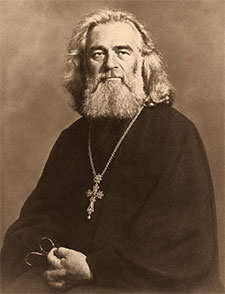 Protopresbyter Michael Afanasyevich Polsky (November 6, 1891 – May 21, 1960) was an Orthodox clergyman, theologian, ecclesiastical writer, and publicist, and one of the prominent representatives of the Russian Church Abroad, who left behind a significant legacy in preserving the memory of the New Martyrs and Confessors of the twentieth century.
Michael Afanasyevich was born in the Cossack village (stanitsa) of Novotroitskaya in the Kuban region into the pious family of the reader (psalomshchik) Afanasy Ivanovich Polsky and Lyubov Grigoryevna, née Tolstova. From an early age, he was raised in a church environment, and family traditions instilled in him a reverence for divine services and a love for the Orthodox Church. Having received his initial theological education at the Stavropol Theological School, he continued his studies at the Stavropol Theological Seminary, graduating in 1914 with first-class honors.
Even before receiving holy orders, Michael Afanasyevich dedicated himself to missionary work. In 1914, he was appointed district missionary for the Stavropol Diocese, later continuing this work in the Kuban region. His labors were directed toward defending the Orthodox faith against the spread of sectarian teachings. In 1916, he was conscripted into military service, attained the officer’s rank of lieutenant (poruchik), and served in the 492nd Barnaul Infantry Regiment. Following his discharge from the military, he returned once more to ecclesiastical work.
On July 29, 1920, Michael Polsky was ordained to the diaconate, and shortly thereafter to the priesthood. His pastoral ministry unfolded during a turbulent era of revolutionary upheaval and the onset of persecutions against the Russian Orthodox Church. Moving to Moscow, he continued his theological education, studying privately under professors of the Moscow Theological Academy after its formal operations had effectively ceased. During this period, Father Michael grew close to zealous defenders of Church Tradition and spoke out against the Renovationist movement, which sought to alter the traditional structure of church life.
For his ecclesiastical stance and opposition to Renovationism, the priest was arrested in 1923 and imprisoned in Butyrka Prison. He was subsequently sent to the Solovki Special Purpose Camp, where he shared the fate of countless imprisoned archpastors, pastors, and laypeople. At Solovki, Father Michael performed grueling physical labor, including alongside Bishop Hilarion (Troitsky), who was later glorified among the Hieromartyrs. What he endured during his camp imprisonment became one of the most defining testimonies of his life and later found reflection in his memoirs.
Upon his release in 1926, his trials were far from over: the priest was sentenced to three years of exile in Ust-Sysolsk (now Syktyvkar). Unable to accept the ecclesiastical course associated with the 1927 Declaration of Metropolitan Sergius (Stragorodsky), Father Michael found himself among those clergy who continued their ministry outside official church structures. At the end of 1929, he escaped from exile, lived underground in Moscow for a time, and in March 1930 managed to cross the Soviet-Persian border. Leaving his Homeland, he carried with him collected accounts of the persecutions of Orthodox clergy and faithful, recognizing the vital importance of preserving testimonies of what was transpiring in the Soviet state.
Thus began a new chapter in his life—ministry in the Russian Church Abroad. After a stay in Tehran and his arrival in the Holy Land, Father Michael served for a time with the Russian Ecclesiastical Mission in Palestine. In 1934, he was appointed rector of the Russian Orthodox community in Beirut, and in 1935 he was elevated to the rank of archpriest.
In 1938, Father Michael relocated to Great Britain and became rector of the Dormition Parish in London. There, his pastoral work continued amidst the Russian émigré community, which preserved faithfulness to the ecclesiastical traditions and spiritual heritage of pre-revolutionary Russia. Father Michael participated in the Second All-Diaspora Council in Sremski Karlovci, where he delivered a report titled “On the Spiritual Condition of the Russian People under the Rule of the Godless.” During the years of World War II, despite the bombing of London and severe hardships, he continued to spiritually shepherd his flock.
In 1948, Archpriest Michael moved to the United States and was assigned to the clergy of the Cathedral of the Icon of the Mother of God “Joy of All Who Sorrow” in San Francisco. In December of that same year, he was elevated to the rank of protopresbyter. Father Michael also played a significant role in the ecclesiastical and canonical life of the Russian emigration, serving as an expert on canonical matters and participating in the court proceedings regarding the ownership of the Holy Transfiguration Church in Los Angeles. In the years that followed, he continued his pastoral ministry in San Francisco until his retirement in 1959.
A special place in the legacy of Protopresbyter Michael Polsky belongs to his literary and scholarly work. His life’s primary mission became the gathering of testimonies concerning the persecutions against the Russian Church and the fates of those who suffered for the faith. In 1931, his book The Position of the Church in Soviet Russia: An Essay by a Priest Who Escaped from Russia was published in Jerusalem, becoming one of the earliest accounts of the plight of Orthodox Christians under Soviet rule. Later, his works The Canonical Position of the Supreme Church Authority in the USSR and Abroad (1948) and In Defense of the Orthodox Faith Against Sectarians were published, alongside numerous theological and ecclesiastical-publicistic articles.
His most monumental work was the two-volume collection The New Martyrs of Russia, the first volume of which was published in 1949 and the second in 1957 at Holy Trinity Monastery in Jordanville. This extensive work was grounded in the author’s personal recollections, collected documents, eyewitness accounts, and testimonies concerning the fates of Orthodox archpastors, clergy, monastics, and laypeople who suffered during the years of godless persecution. Work on a third volume remained unfinished.
The historical significance of this collection is difficult to overestimate: for several decades, it served as one of the most comprehensive sources of information on the New Martyrs and Confessors of the Russian Church of the twentieth century. Thanks to Father Michael’s labors, the memory of many who suffered for the faith was preserved within the church life of the Russian Diaspora, subsequently becoming vital source material for historians of the persecutions and for the restoration of the memory of the victims of the godless era.
Protopresbyter Michael Polsky reposed on May 21, 1960, in San Francisco. His life’s journey encompassed ministry in pre-revolutionary Russia, revolutionary upheavals, imprisonment, the Solovki camp, exile, and decades of labor in the vineyard of the Russian Church Abroad. The literary legacy he left behind stands as a testament not only to the personal destiny of a clergyman, but to a tragic epoch in the history of Russian Orthodoxy. Occupying a place of particular honor within it is his dedication to preserving for posterity the names and testimonies of those who carried the faith through years of persecution, suffering, and deprivation.
Hieromonk Roman (Kiselev)
|