 |
SERMONS |
 |
 |
 |
 |
|
Priest
Serafim Gan
"LET US FAST WITH AN ACCEPTABLE FAST" In these bright and great days of holy Great Lent, the Church of Christ calls upon us to salvific self-denial, of which the Moldavian elder, the Holy Schema-Archimandrite Paisius Velichkovsky wrote: ТIf you restrain your stomach, you enter heaven, for restraint is the slaying of sin, the departure from passions, the beginning of spiritual life and the guarantor of eternal blessings.У
On Forgiveness Sunday evening, the monks and seminarians gather
in Holy Trinity Cathedral for small compline with the rite of forgiveness.
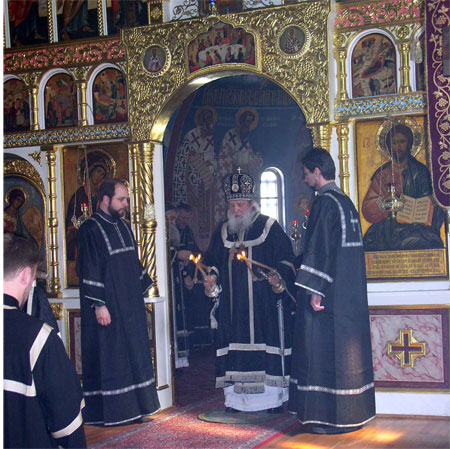
After reading the prayers before sleep, His Eminence Metropolitan
Laurus gives a sermon, in which he asks forgiveness of the monastic
brethren and reminds the worshipers of the need to forgive those
"that hate and wrong us" for the attainment of the Kingdom
of Heaven. Then, the rite of forgiveness with the joyful singing
of the Paschal sticheron follows. After asking every person in turn
for forgiveness, each returns to his cell with a pure heart and
peaceful spirit to await the beginning of the "sorrowful days
of Great Lent."
The following morning, on Clean Monday, midnight office begins at
5:30 am, followed by Great Lenten matins, which contains several
special characteristics. After the great litany, "alleluia"
is sung instead of "Lord God," and then the trinitarian
hymns of the tone. Instead of two cathismas, three are read, and
at the end of each, edifying teachings of Saint Efrem of Syria.
Then, the officiating clergyman reads the prayer ТSave, O God, Thy
people,У after which the canon of the saint of the day with the
so-called triodion of the Lenten Triodion and the Old Testament
songs from the end of the Psalter are solemnly sung. After the 3rd
song, His Eminence reads the chronicles from Lavsaik, and after
the 6th, the life of the saint of the day from the Prologue. After
the first hour, the monks and seminarians, along with pilgrims,
venerate the icons and the relics of saints in the upper Trinity
Cathedral and in the lower Chapel of St. Job, where a reliquary
with the relics of the Kiev-Pechersk saints is kept, along with
a venerated copy of the Pochaev Icon of the Mother of God, and other
holy items. After a brief respite, hours are read with the cathismas
and teachings from The Ladder of St. John of the Ladder, the great
teacher of monastics and the abbot of the monastery of Mount Sinai.
At the end, vespers for the next day begins. All the above services
include the reading of prayers of St. Efrem of Syria which express
a fervent striving of man for repentance and good works. After vespers,
a litany is performed for all Тour forefathers, fathers and brethren.У
Then, the brethren shares a meal, from of oil, during which the
teachings of St. Feofan, the Recluse of Vysha, From Monday to Thursday,
great compline is served with the reading of the Great Canon of
St. Andrew of Crete. After evening prayers, everyone venerates the
holy icons and receives the His Eminence the Superior’s blessing.
On Wednesday and Friday, the liturgy of pre-sanctified Gifts in
is performed in the hierarchal rite. At the end of Liturgy, during
Clean Week, the canon to Great Martyr Theodore the Tyro is read,
followed by the blessing of the kolivo [soft-shelled wheat or barley,
sweetened with sugar, honey, raisins or dried fruit] in memory of
the great miracle of St. Theodore. In the evening, great compline
is served with the canons for preparation for Communion, the akathist
to the Mother of God and the evening prayers, during which all the
residents, seminarians and pilgrims make confession. In the morning
of Theodore Saturday, midnight office begins at 5 am; after matins,
the canon for Divine Communion is sung by two kliroses. After a
brief rest, hours begin, followed by liturgy, when everyone partakes
of the Holy Mysteries.
All-night vigil on the eve of the Triumph of Orthodoxy begins at
7 pm. It is interesting to note that before the establishment of
this holiday in the year 842, the first Sunday of Great Lent was
dedicated to the Holy Prophets of God, as is evidenced by the idiomelon
of the day in the 6th tone on the praises on this holiday: ТIn time
of abstinence Moses received the Law and drew the people [to it];
Elijah, while fasting, closed up the skies; and through temperance
did the three children of Abraham vanquish the iniquitous tyrant...У
His Eminence Metropolitan Laurus officiates at the hierarchal liturgy
along with a host of monastic clergymen, teachers of the seminary
and guests in the priestly rank. After Liturgy, the Тprayer for
the conversion of those in errorУ is sung, with the rite of Orthodoxy.
After the anathemization of heretics who do not accept the teachings
and laws of the Holy Church, the protodeacon intones ТEternal MemoryУ
for all the defenders of Orthodoxy, then ТMany YearsУ to His Eminence
Metropolitan Laurus and all who observe the Faith of Christ.
The following day, the brethren and students return to their obediences
and studies. Despite the long, rule-bound services with many prostrations,
and the strict fast with Тdry foodУ [without oil], the residents,
as the Apostle said, Тin faltering, they falter not.У
In conclusion, I would like to recall the words of the famous Hieromonk
Arsenii, who labored on Mount Athos, in ТRusikaУ in the 19th century:
ТThe victory over the flesh is glorious and ever-wondrous; such
a one partakes not of earthly, but of heavenly food; he is as one
who leaves a stench-filled place and enters a splendid garden.У
May God grant all of us to spend this time in pleasing Him and become
worthy of the victorious entry into this splendid garden of restraint,
praising the brightest resurrection of the Mankind-loving God! Priest Serafim Gan, Associate Editor |
|
|
|
|