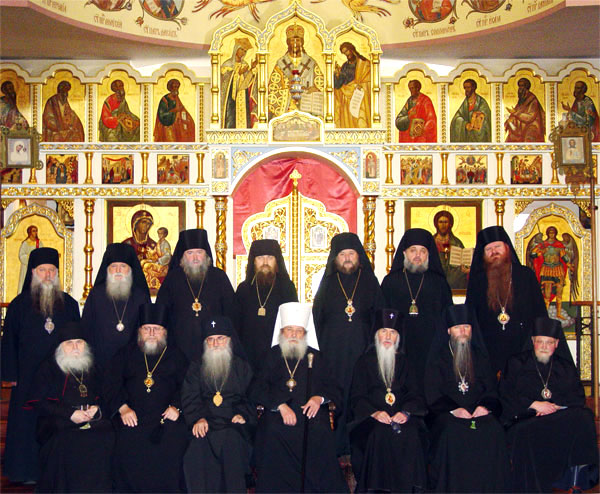
Epistle
to the Flock from the Council of Bishops
of the Russian Orthodox Church Outside of Russia
Held in December 2003 in New York
In the Name of the Father and the
Son and the Holy Spirit!
The Council of Bishops, having gathered at this time, as had preceding
Councils, under the auspices of the Holy Miracle-working Kursk-Root
Icon of the Mother of God, had as its main task the matter of the
relationship between the Russian Orthodox Church Outside of Russia
and the Russian Orthodox Church/Moscow Patriarchate.
The session was preceded by an All-Diaspora Expanded Pastoral Conference.
The bishops who were present at the Conference were able to hear
the entire scope of opinions from practically the entire clergy
of the Church Abroad. It can be decisively stated that not one person
doubts the necessity of having dialog with representatives of the
Moscow Patriarchate towards overcoming existing divisions.
A significant portion of the participants once again raised the
matter of condemning Sergianism and ecumenism. Without a doubt,
this resounded in the work of the Council and will be taken into
account going forward.
Before us stands the question not of merging or uniting churches,
but the establishment of normal church relations between two parts
of the once-whole Russian Church, parts which found themselves separated
for historical reasons.
As is well known, the Russian Church Abroad was established on temporary
principles in the 1920-s in accordance with a ukase of Patriarch
Tikhon. It was assumed that the communist state would fall in a
few years, and that Russian emigres, headed by their archpastors,
could return to their homeland.
Unfortunately, because of our sinfulness, this did not occur! The
godless regime enslaved the Russian people for over 70 years and
inflicted brutal persecution upon faith in Christ.
Concurrently, over the years of its wanderings, the Church Abroad
spread to almost all countries of the world. New dioceses were formed,
churches were built with parish schools, monasteries were established,
youth and patriotic groups were formed, newspapers were published
along with journals and books. The goal for the pastors of the Church
Abroad became not only to preserve the Orthodox faith and Russian
culture within its flock, but to attract those of other faiths to
Orthodoxy, instilling in them our Church traditions. And so, in
many countries, parishes were born consisting almost exclusively
of the local population which converted to Orthodoxy. Over the years,
even the composition of the parishioners changed. While the older
generation passed to another world, their children and grandchildren
began to forget the Russian language and lost the cultural legacy
of their parents. Mixed marriages became a common occurrence. These
factors presented a new challenge for the Church Abroad, which her
founders did not foresee, to wit, that the Russian Orthodox Church
must proselytize and bring the world the light of Orthodoxy.
We, Russians who find ourselves abroad, must thank God that, being
in complete freedom from godless communism, our Church was able
to preserve the purity of the Orthodox faith, and not submit to
the fatal temptations of ecumenism and modernism.
At the same time, in our much-suffering homeland, the godless state
employed brutal terror and every means possible to enslave the Russian
Church.
Fortunately, this has come to an end! As our saints foretold, God
showed mercy to our Russian people and freed them from the yoke
of the godless state. May the earth be glad and the heavens rejoice:
ЙџѕBabylon the great is fallen, is fallen,Йџ the great harlot! (Rev.
18:2).
One can argue endlessly on the ambiguity of socio-political shifts
in Russia, but the change in the situation of millions of the faithful
is apparent to all.
Now we have become witnesses to that relentless spiritual renewal
occurring in our Homeland: hundreds and thousands of Russia people
are being baptised, churches and monasteries are being rebuilt,
theological academies, seminaries and parish schools are opening,
religious books are being published in enormous numbers!
We, living abroad, must rejoice at the spiritual wakening of the
Russian people, and thank God that He heard our prayers and the
prayers of the host of New Martyrs of Russia for the salvation of
Russia.
Maybe it will not be as rapid as one would like, but the Church
in Russia is gradually recognizing the need for destroying the wall
that has thus far divided the Russian flock in the Homeland and
that abroad. Indeed, the Chuch in Russia glorified the host of New
Martyrs, as well as the Royal Family, which was unimaginable under
the godless regime, It also condemned the principle of the Church
serving the interests of the state Уin essence, the principle of
Sergianism. A great number of clergymen and laypersons in Russia
insist upon the withdrawal of the Russian Church from the World
Council of Churches. This all gives hope that with time the other
wounds inflicted upon the Russian Church by the militanly atheist
regime will be healed.
Now we must agree upon how to overcome the obsolete and possible
new misunderstandings between both parts of the Russian Church,
and to agree upon how to resolve all future problems of interrelations
peacefully and in the spirit of truth.
It is our firm conviction that the Church Abroad, in light of the
tasks which stood before her in regard to the nourishment of such
a scattered and disparate flock, must preserve her freedom and administrative
independence. At the same time, it is desirable, in those places
where parishes of the Church Abroad and of the Moscow Patriarchate
exist side by side, to work out a plan of friendly coexistence in
the fulfillment of the single mission of witnessing Christ. The
matter of full eucharistic communion may be only a final result
of the conciliar actions of both parts of the Russian Church, to
be prepared by the corresponding committees.
For the resolution of problems relating to overcoming confrontations
between the two parts of the Russian Church, the Council of Bishops
formed a committee which will exhaustively examine questions of
relations between the two parts of the Russian Church and will offer
measures acceptable to both sides.
Recognizing the importance and responsibility of the developing
process of negotiations, we find it desirable to convene in the
future a Fourth All-Diaspora Council.
We invoke God's blessing upon our entire faithful flock and ask
for their holy prayers for us, your archpastors, who wish to preserve
our flock in unity and the purity of the Orthodox faith.
Most-Holy Mother of God, our Guide, continue to lead us according
to the commandments of Your Son and the Holy Fathers who pleased
Him. Amen.
+Metropolitan Laurus
+Archbishop Alypy
+Archbishop Mark
+Archbishop Hilarion
+Archbishop Kyrill
+Bishop Ambroise
+Bishop Evtikhii
+Bishop Agathangel
+Bishop Daniel
+Bishop Gabriel
+Bishop Alexander
+Bishop Michael
+Bishop Agapit
+Bishop Peter
|
